หน้าเว็บ

วันจันทร์ที่ 28 ตุลาคม พ.ศ. 2556

Loy Krathong Festival thailand


Loy Krathong Festival One of the most popular festivals in early November is the Loy Krathong Festival. It takes place at a time when the weather is fine as the rainy season is over and there is a high water level all over the country.

“Loy” means “to float” and a “Krathong” is a lotus-shaped vessel made of banana leaves. The Krathong usually contains a candle, three joss-sticks, some flowers and coins.

In fact, the festival is of Brahmin origin in which people offer thanks to the Goddess of the water. Thus, by moonlight, people light the candles and joss-sticks, make a wish and launch their Krathongs on canals, rivers or even small ponds. It is believed that the Krathongs carry away sins and bad luck, and the wishes that have been made for the new year due to start. Indeed, it is the time to be joyful and happy as the sufferings are floated away.

The festival starts in the evening when there is a full moon in the sky. People of all walks of life carry their Krathongs to the nearby rivers. After lighting candles and joss-sticks and making a wish, they gently place the Krathongs on the water and let them drift away till they go out of sight.

A Beauty Queen Contest is an important part of the festival and for this occasion it is called “The Noppamas Queen Contest”. Noppamas is a legendary figure from the Sukhothai period. Old documents refer to her as the chief royal consort of a Sukhothai King named “Lithai”. Noppamas was said to have made the first decorated Krathong to float in the river on the occasion.

In Bangkok, major establishments such as leading hotels and amusement parks organise their Loy Krathong Festival and the Krathong contest as major annual function.

For visitors to Thailand, the Loy Krathong Festival is an occasion not to be missed. The festival is listed in the tourist calendar. Everyone is invited to take part and share the joy and happiness.

___________________


New Year’s Day Thailand is well-known for her festivals which take place all the year round. Most of these festivals are influenced by Buddhist and Brahminical religions, however, with the passage of time a number of them have been adopted in deference to the international practice.

Actually, the official New Year’s Day of Thailand has undergone several changes. Once it used to fall at the end of November. Later, during the reign of King Rama V(1868-1910) it was moved to a date round about April and then New Year’s Day was changed to April the first. The universal practice of celebrating the new year on January 1 was adopted in 1941 in deference to the western calendar and this is one of a number of changes aimed at modernising the country.

Though January 1 is regarded as official New Year, the majority of Thais still regard the middle of April (Songkran) as their new year’s day, and on this auspicious occasion a week-long celebration is held throughout the kingdom. Most of activities on Songkran Day involve water throwing, building sand pagodas and pouring lustral water on the aged as a means of blessing. To be frank, a celebration on January 1 is not so popular as that of Songkran. Normally, before the upcoming January 1, people will exchange greeting cards and gifts. Since on this auspicious occasion, a few grand celebrations are held in the kingdom, people take this opportunity to travel upcountry to visit their relatives or spend holidays at a tourist attraction site, while those stay at home will prepare food and other necessary items to make merit on the early morning of January 1 and then take part in various charitable activities held in various places.

At the same time, several companies take this opportunity to give a bonus and announce promotions to their employees who later cash money to buy gifts for relatives and friends before heading to their hometown for a long vacation.

Obviously, in Thailand people celebrate New Year three times a year, namely ; the Thai traditional New Year or Songkran, January 1 and the Chinese New Year. Out of these, Songkran is the most joyous occasion which draw people from all walks of life to take part in a week-long celebration. Meanwhile, the Chinese New Year is important especially for Thai organisations will close their business for several days so that the employers and their employees will be able to celebrate the auspicious occasion with their relatives at home or spend a long holiday in a place they like. 

Khlong Lat Mayom: Floating market realness.

The smell of incense and jasmine waft up my nostrils as soon as we enter the markets. It’s pretty and calming, much like this side of the canal where there are only a handful of craft stalls.
Over the bridge is where we most want to go, the smell of roasting BBQ pork guides us to the Klong Lat Mayom, the Bangkok floating markets popular with the locals.
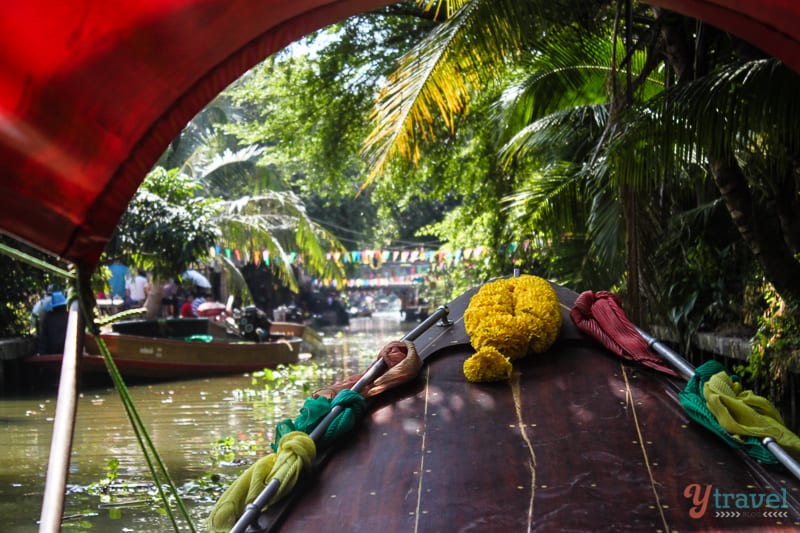
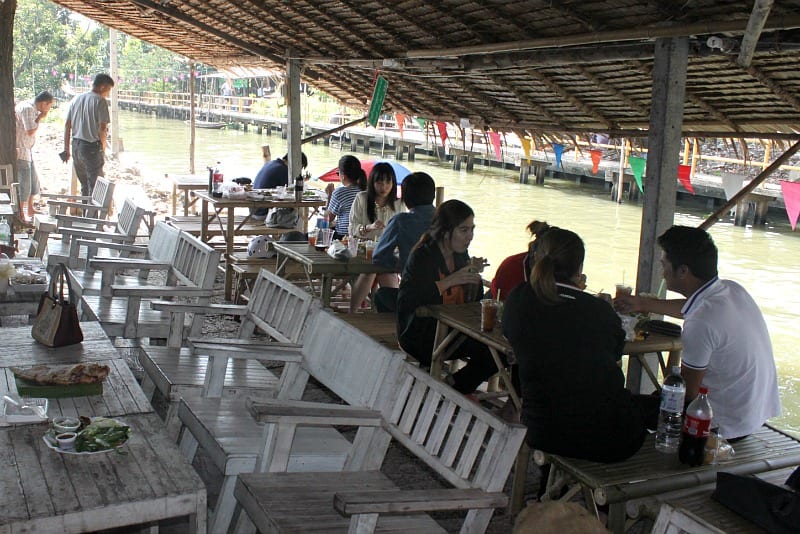
Flags stretch across the canals, tied to the thatched roofs covering the markets.
Bangkok Floating Markets
We’re here early and there’s plenty of space to move amongst the colourful stalls.
The crowds thicken at Lat Mayom during lunchtime – peak hour.
“That’s when we play musical chairs,”
our guide Tim shares with us a little about the Klong Lat Mayom Floating markets.
The floating markets are only about 30 minutes from Bangkok on the Thonburi side of the river. They are lessor known than the heavily touristed floating markets of Damnoen Saduak and Amphawa.
Whilst Damnoen and Amphawa are more energetic with traffic jams of long tail boats, Klong Lat Mayom is a narrow canal with a more authentic feel, with the majority of vendors and eating areas on land.
Bangkok Floating Markets
Tim describes these markets as a way of life of the local people.
“Not spoilt by tourists. No tourist goods or souvenirs.”
It’s also the sort of place travellers love – the authentic local markets. I envisioned a few years down the track the invasion of the falangs (foreigners) once word began to spread.
The market is only a few years old and is the joining of lots of small local markets in the nearby canal neighbourhoods, and the food is fantastic.

It’s a market made for the local people and Thai tourists.


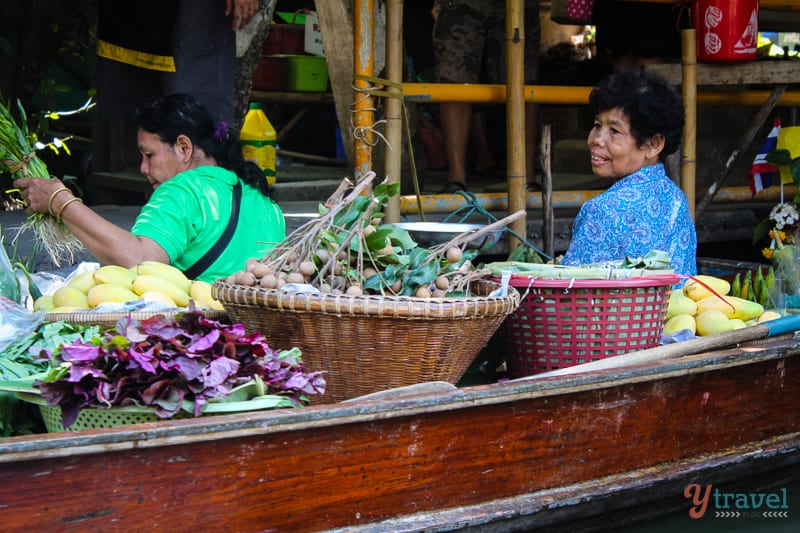
The biggest draw card to the markets are the food stalls. There is no Thai dish you cannot find here. The hardest decision is narrowing down your choice to one or two, or maybe five. Squashed in amongst the food and tables lining the canals handicrafts, plants and clothing stores too.
“Thai people love shopping. After we’re full, we look for beauty and things that give us enjoyment.” Tim chuckles as she steers us through the markets.
There’s no room in my suitcase for the things that give me enjoyment, but there’s certainly room in my stomach to get full.
We walk past a few stalls and I mentally pick out several dishes to come back and try. My grin widens and my tummy rumbles even louder at the prices of the meals, 20 baht for fish cakes, 30 baht for a curry, sticky rice – we certainly were in the locals market.
Bangkok Floating Markets
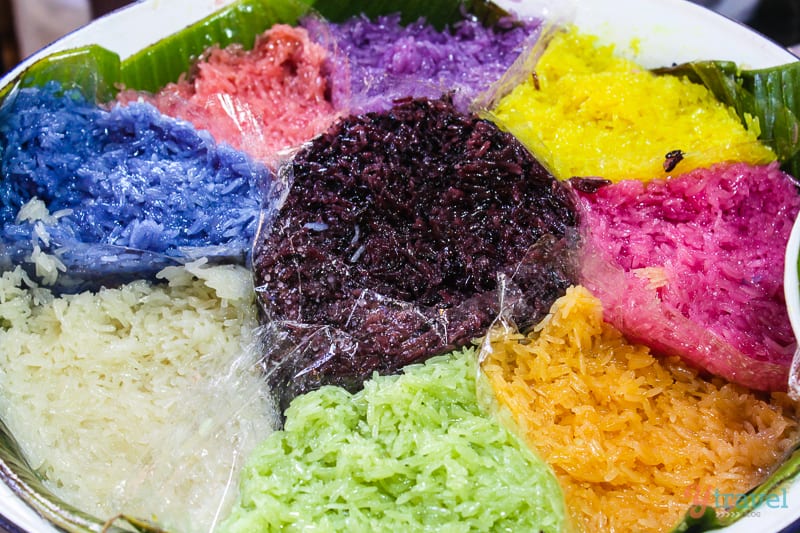
COLOURFUL STICKY RICE
Bangkok Floating Markets
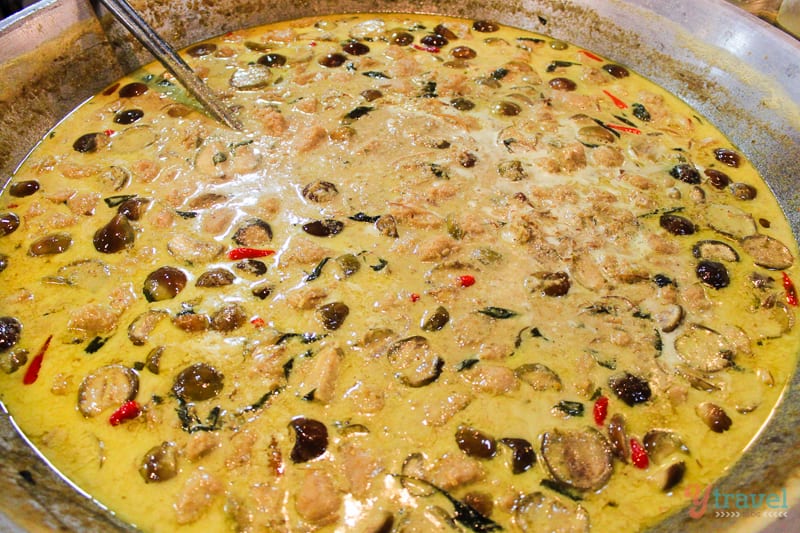
THAI GREEN CHICKEN CURRY
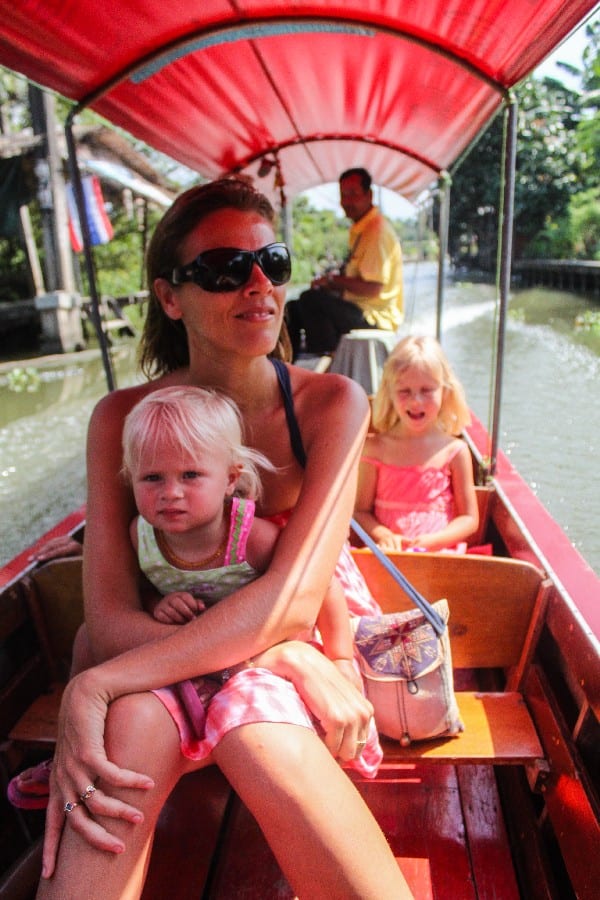
Tim takes us to the long tail boats waiting on the canal.
“We go to the local village first, before it gets to busy.”
I grab a bag of Kanom Tarn from a long tail boat first. The moist sponge cake, topped with http://www.ytravelblog.com/bangkok-floating-markets-2/shredded coconut – one of my fave Thai desserts – is perfect for the gentle ride to the village. Not too sweet and silky smooth. Catfish jump out of the water beside the boat to try and get some.
Bangkok Floating Markets
KANOM TARN
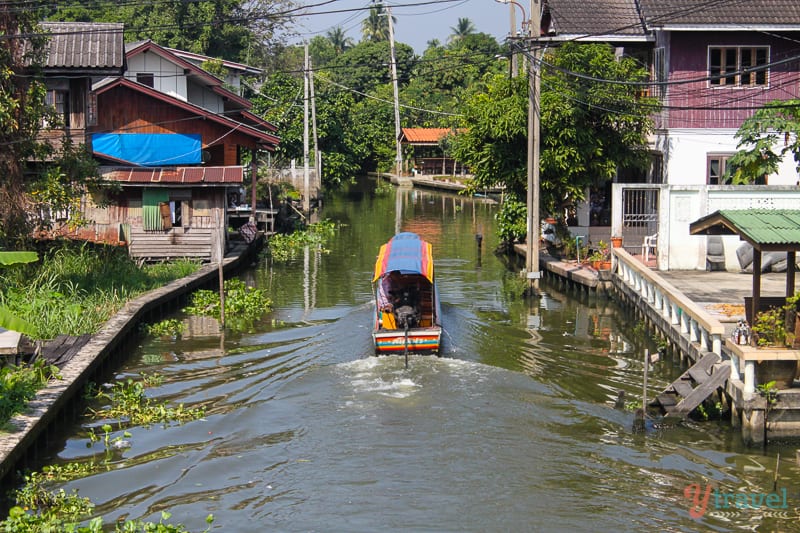
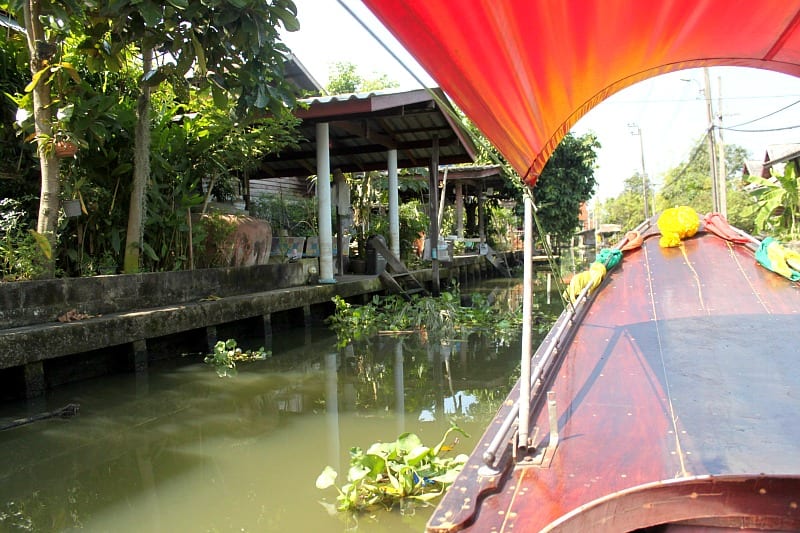
We’re content as we putter through the back canals of suburbia Bangkok.
Bangkok Floating Markets
Many of the homes have large gardens on the edge of the canals, a place to sit in solitude – almost unheard of in Bangkok.
I took to it immediately.
We pull up at the dock, cross a bridge, and walk along a footpath to the row of homes that open their doors to the odd passing tourist. Mangos, papayas and bananas dangle over our heads and we stop to point them to the girls.
“Oh look Mummy, the papaya’s your favourite and Savannah loves banana and I love mango!”
“Yes so very cool!”
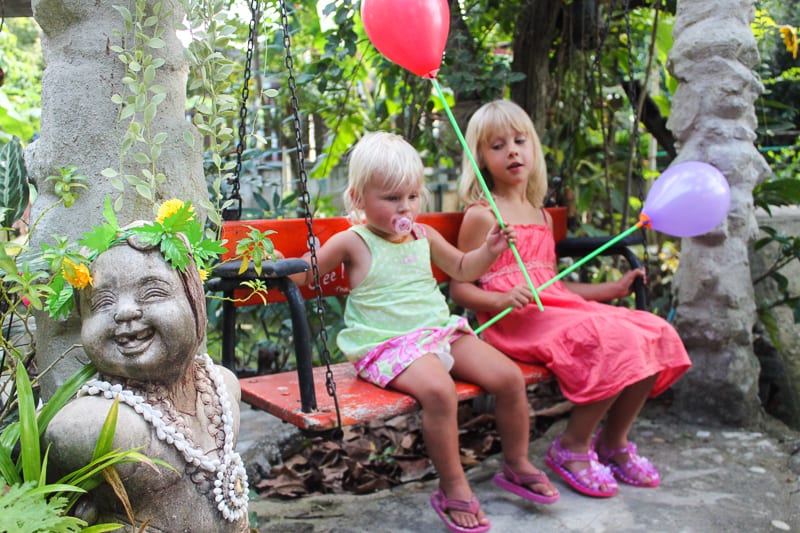
We enter the first garden, there is a pretty red swing the girls sit on and play with their colourful balloons the owner of the house gave to them. They are happy. We walk around the gardens soaking in the serenity before moving to the next house.
Bangkok Floating Markets
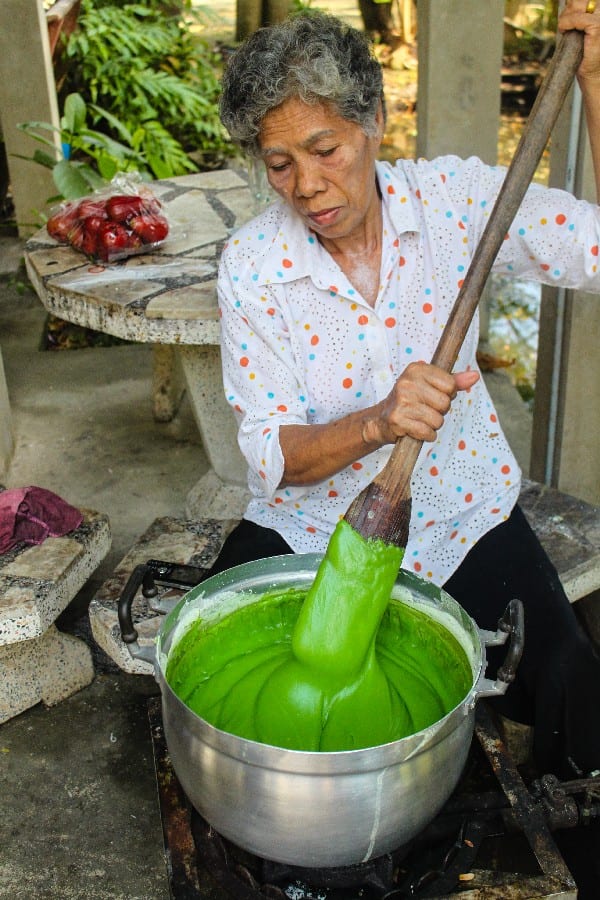
Grandma sits on a stool in the shade, a steel cauldron sits on a small cooking stove in front of her adding to the already stifling Bangkok heat.
Here by the canals, a slight breeze blows, but still the beads of sweat run down her face.

For 30 minutes she sits and patiently stirs, eyes on the green gooey pandan.

Bangkok Floating Markets
We become just as mesmerized as Tim describes how she will make the popular Thai dessert.
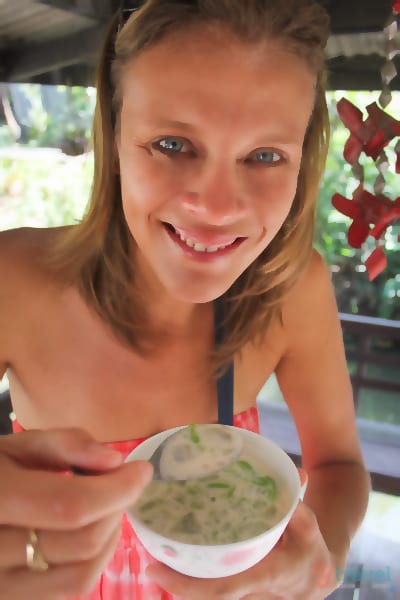
Once cooked, she’ll take the pandan, run it through a hand operated machine which cuts it into worm-like noodles. And then she’ll pour coconut milk over the worms and top it with shaved ice. It doesn’t look too welcoming, but the sweet freshness is exactly what I need on yet another hot Bangers day.
eating Pandan Thai dessert
A store set up in a room outside the house also sells a variety of small sweets made from coconuts. At 10 baht a container how could you say no to three different types?
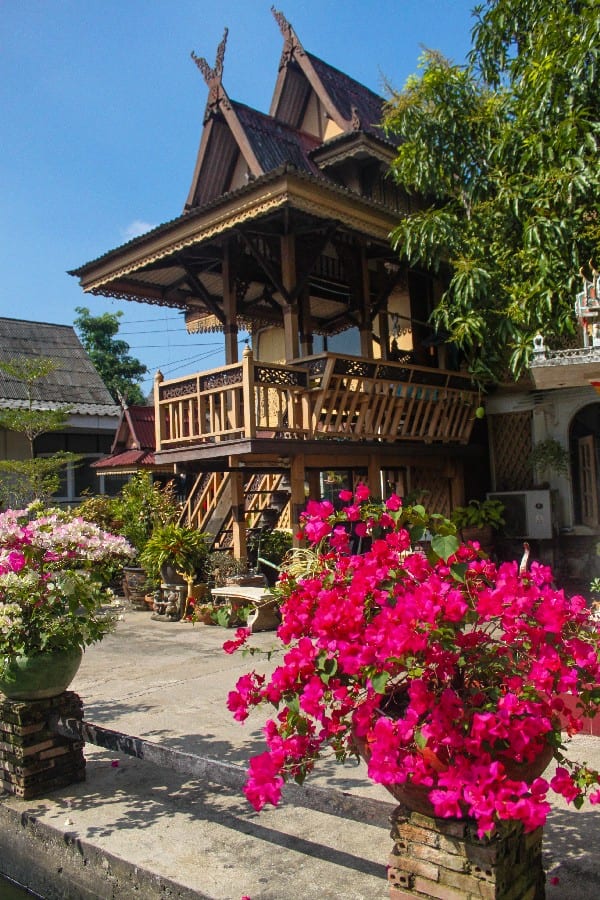
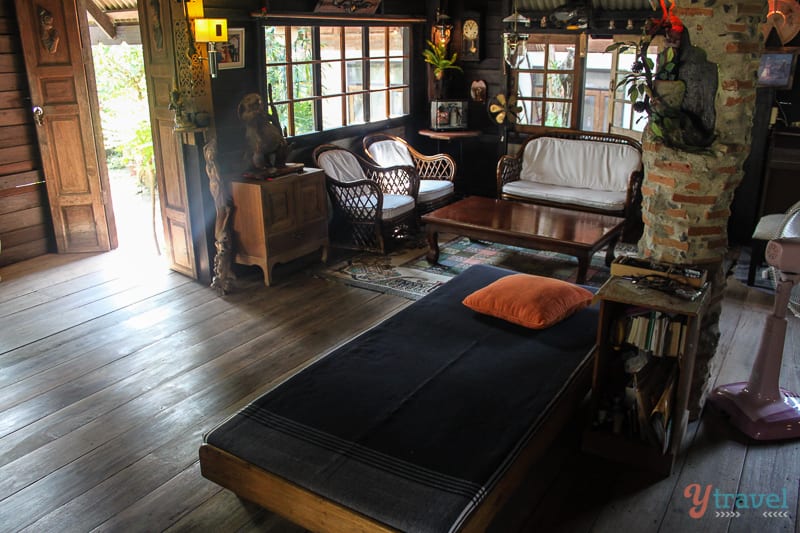
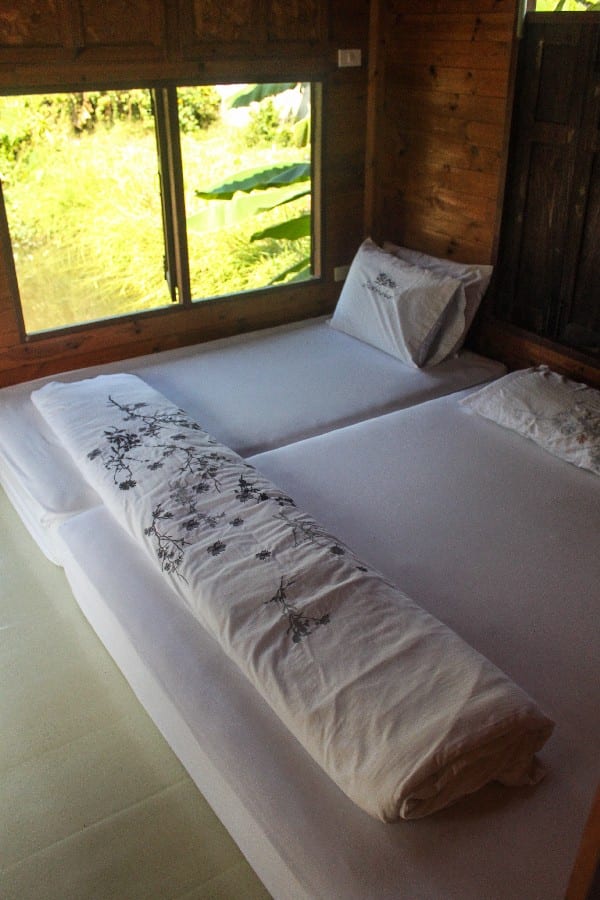
Tim takes us to the end house, a guest house for those wanting a village stay. It’s a quirky wooden shack with unusual furnishings. Strange eclectic folk tunes play in the background as we wander upstairs to have a poke about.
I could picture myself spending a weekend here to escape the madness of Bangkok. The sun chair out the back beckoned me to sit with a glass of wine and a good book.
Bangkok Floating Markets
We walk along the footpath and around the corner to meet the boat.
A cyclist rings his bell and waves hello, a little further down an elderly man with a long Ho Chi Minh beard patiently chops washed up debris from the previous years flood to make charcoal, and we are soon tooted out of the way by the village postman on his motorbike.
Once again Bangkok is fascinating Kalyra as her young mind tries to grasp why the postie is riding around on footpaths.

Tucked away from the madness of inner city Bangkok, there is a peace and tranquility here usually only found in rural Thailand.


The trees, vines and vibrant flowers surround us and the air is fresh and clean.
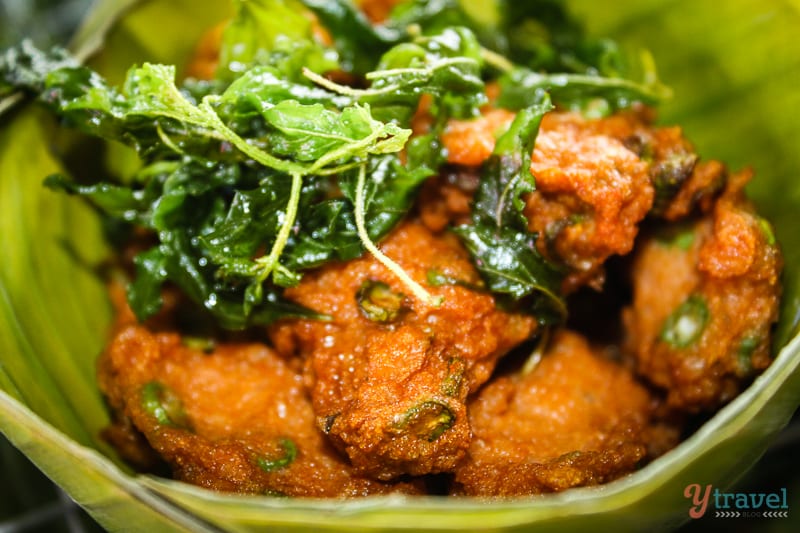
We pick up a bag of fish cakes before boarding the boat back to where the real eating would begin.
Bangkok Floating Markets
FISH CAKES
Bangkok Floating Markets
COLOURFUL CANALS
Bangkok Floating Markets
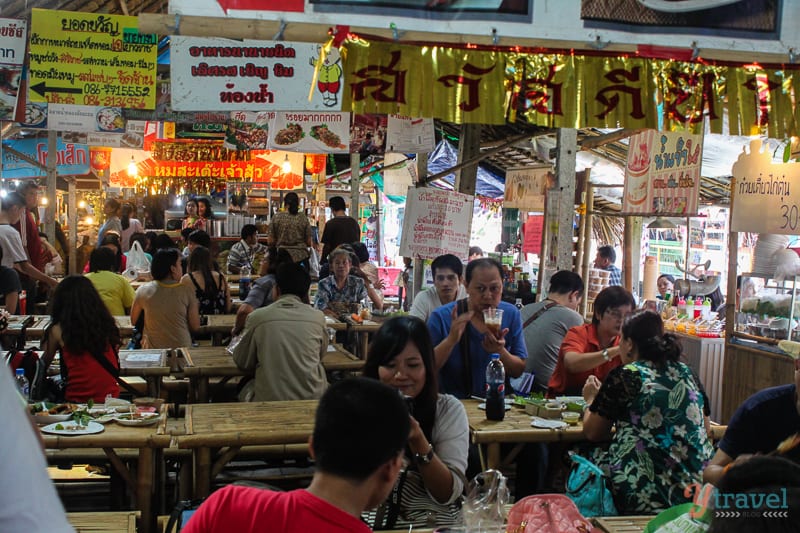
Rows and rows of food stalls line the river and by now it was getting difficult to move. We see only the odd falang (foreigner), their heads bowed down in worship to another bowl of cheap, authentic Thai noodles.
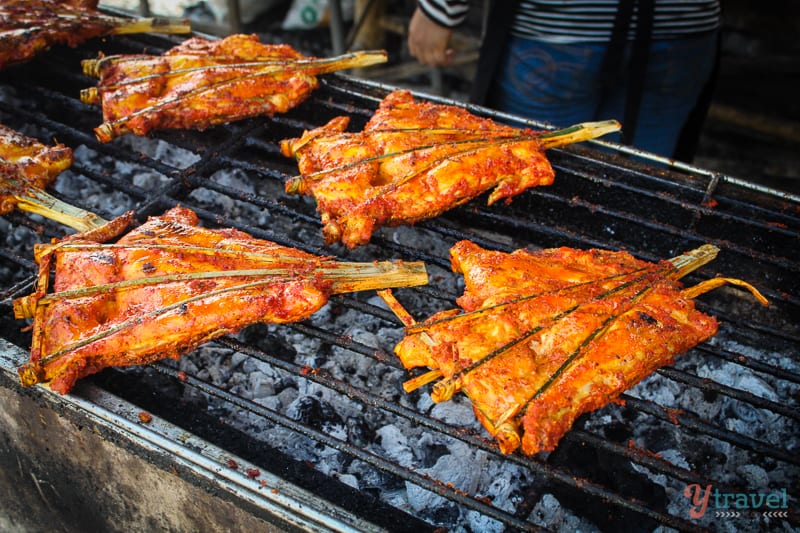
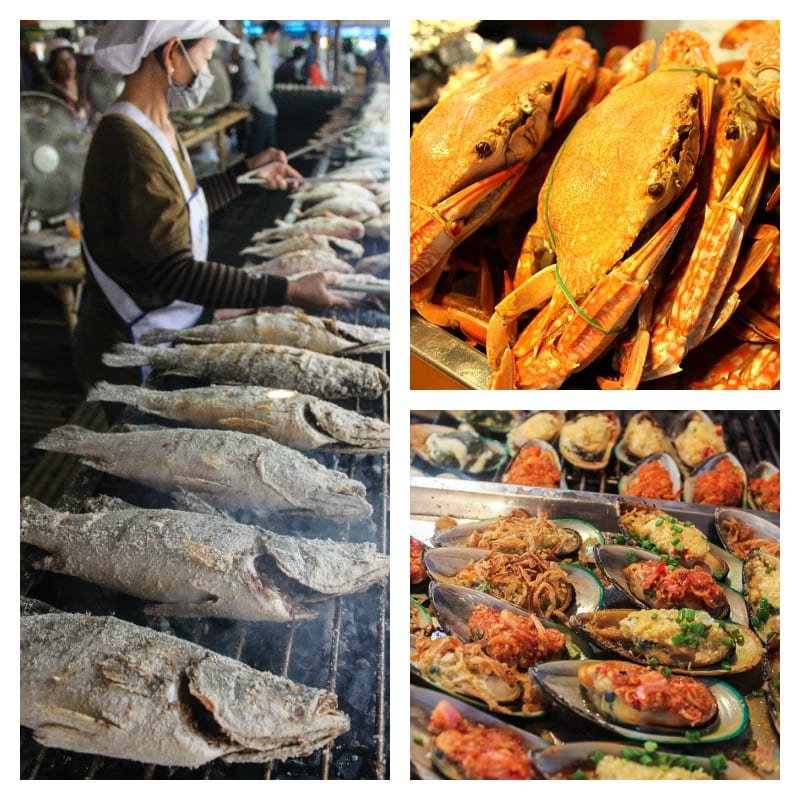
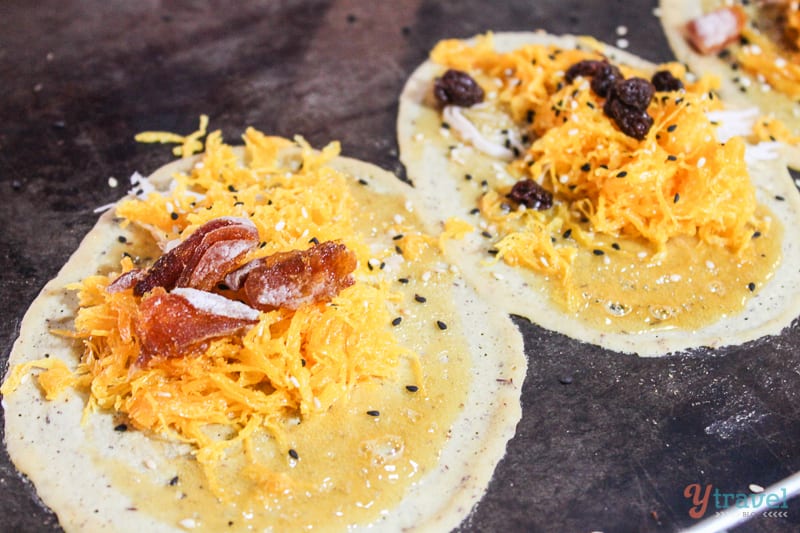
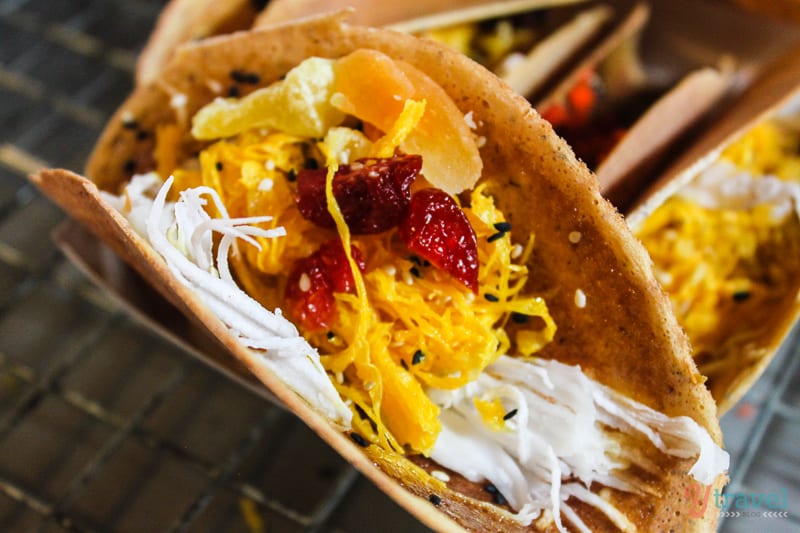
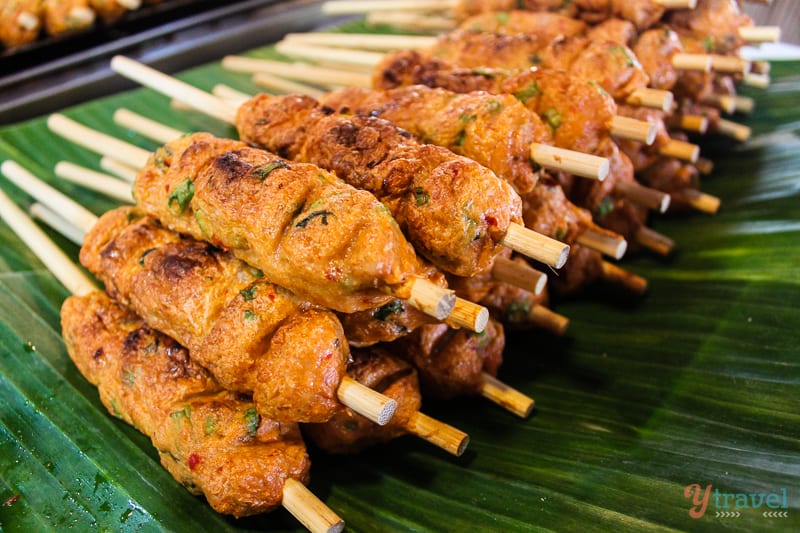
There’s seafood, fresh fruit, BBQ chicken, pork skewers, thai pancakes and much more.
Bangkok Floating Markets
LUNCH TIME IS POPULAR WITH THAIS
Bangkok Floating Markets
RED FISH CURRY
Bangkok Floating Markets
BBQ CHICKEN
Bangkok Floating Markets
LOTS OF SEAFOOD
Bangkok Floating Markets
THAI’S RELAXING AT LUNCH BY THE CANAL
Bangkok Floating Markets
THAI PANCAKES
Bangkok Floating Markets
THAI PANCAKES

Bangkok Floating Markets
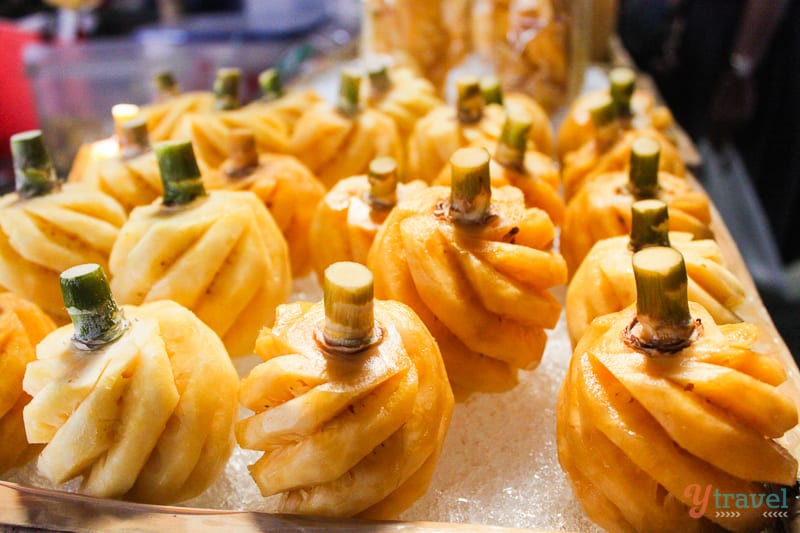
FRESH PINEAPPLE
We could have spent all day eating, but with two small girls who hate crowds, our time was pretty limited. We didn’t have long before meltdown would begin.
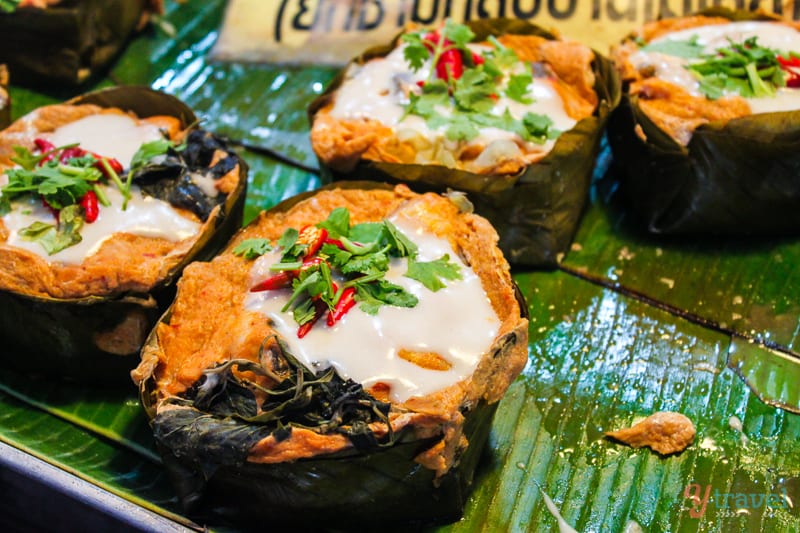
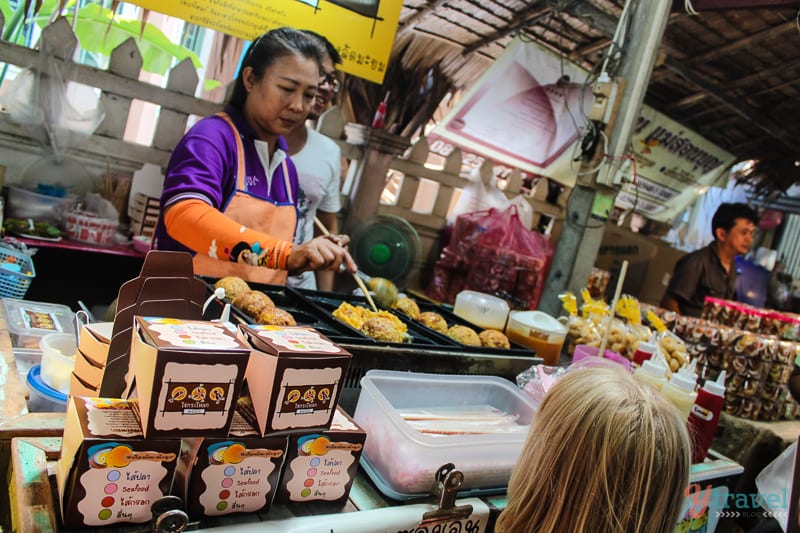
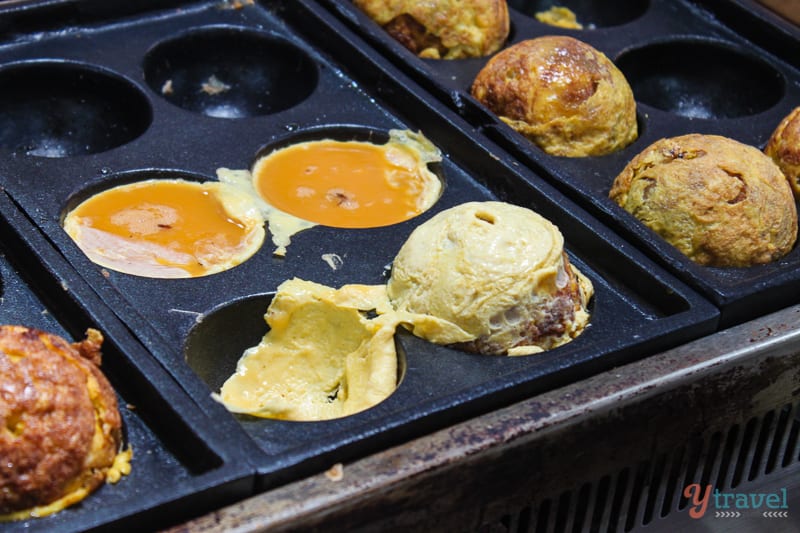
We watched as a lady stood rolling large balls of eggs and mixed seafood in a hot muffin tin. Tim told us they were omelets. A little egg mixture was placed in the container, seafood filling added, and the balls continually rolled around and around until they cooked.
They were delicious and hearty and a good lunch for little Savannah.
cooking Thai omelette
Bangkok Floating Markets
SEAFOOD OMELETTES
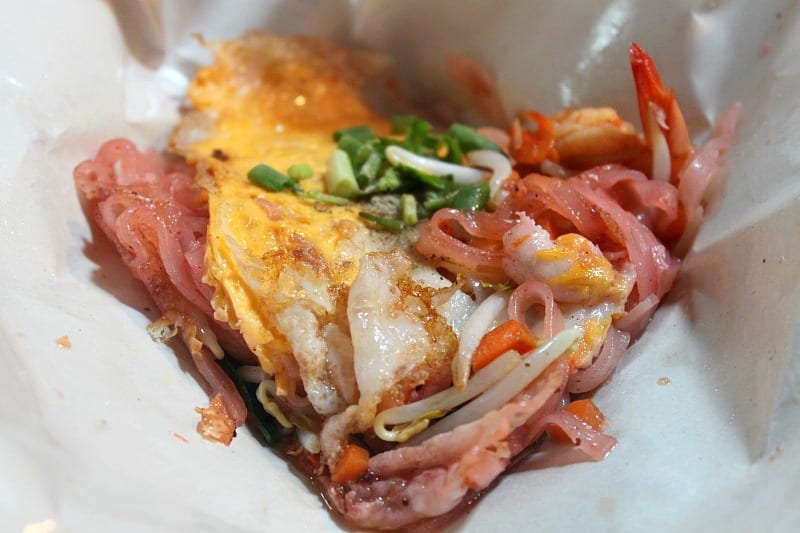
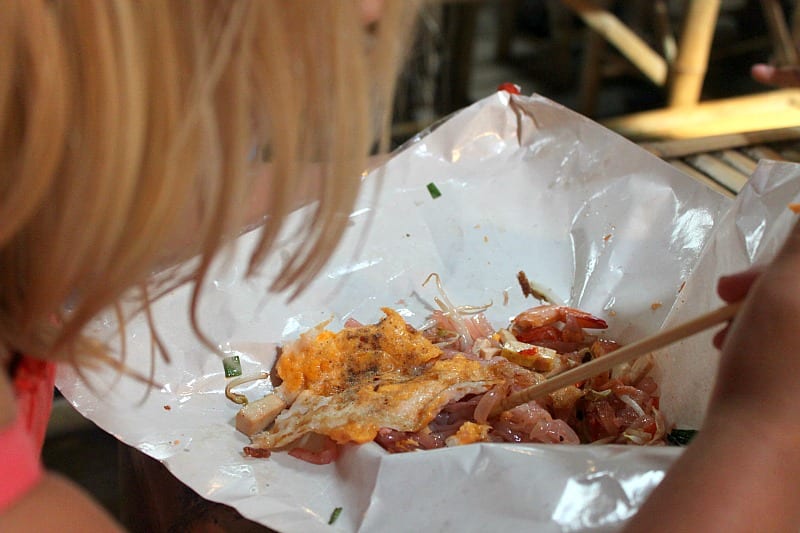
Kalyra settled for her favourite Pad Thai, brought from the boats cooking it on the canal. It came folded up in a white paper, very typical of Thai street food. The taste was on par with it as well.
Bangkok Floating Markets
PAD THAI
Bangkok Floating Markets
We leave with full bellies, but enough space to move to our next restaurant back in inner city Bangkok. It’s a famous one for Thai people, and yes, in Thailand, there is always room for just one more authentic dish.

Opening Hours

Klong Lat Mayom is a weekend market on Saturdays and Sundays from 9:30 am to 4:30 pm. I would suggest arriving for opening time, as it gets pretty busy around lunch time.

Getting There

The market is located on Bang Lamad Road off the Bang Khae-Bang Bua Thong Outer Ring Highway, Taling Chan, Thonburi.
Using the BTS Sky Train, take the Silom Line and get off at Wongwian Yai Station. From there get a taxi (approx 100 baht).

Guided Tours

If you don’t want to go it alone, Tim (our guide) and her team at Absolutely Fantastic Holidays run small private tours direct from your hotel to Klong Lat Mayom.

tample angthong thailand

Phratamnak Khamyat
Location: Amphoe Pho Thong
Phratamnak Khamyat is located in Tambon Khamyat, 2.5 kilometers west of Wat Pho Thong on Ayutthaya Pho Thong Road. At present only four walls of the royal residence remain. The 10x20 meters royal residence, made of brick and plaster, stands eminent in a paddy field. The artistic beauty still remains e.g. motifs around the window, front and back balcony, was painted in red soil and covered with wooden floor.
Wat Khun Inthapramun
Location: Amphoe Pho Thong
Wat Khun Inthapramun
Wat Khun Inthapramun is located in Tambon Inthapramun. It is an ancient temple constructed in the Sukhothai period. Considering the original line of brick remains, it is estimated to be a large temple. The largest and longest reclining Buddha in Thailand, 50 meters from the topknot to the feet, is enshrined here. Originally, the reclining Buddha image was housed in the wihan, but this temple was on fire and was left deserted with the Buddha image in the open for centuries. The image features and size are similar to those of Phranon Chaksi, a reclining Buddha image in Sing Buri Province. Therefore, it is assumed to have been constructed in the same period. The image possesses attractive Buddha features with a serene smiling face attracting respectfulness and faithfulness from people. Thai kings went to pay homage to the image e.g. King Borommakot in 1753, King Rama V in 1878 and 1908. The present king came to present the royal Kathin robes in 1973 and again in 1975. Buddhists from all over the country always make their visits to worship the image.

Moreover, within Wat Khun Inthapramun compound, there are historical remains of basement, some parts of walls, and Buddha image in Luangpho Khao wihan. Inside the all-purpose pavilion, there is a statue of Khun Inthapramun and the skeleton found in the wihan of the reclining Buddha image in 1998 lying on his face with his hands and feet tied up. People believe that this skeleton is of Khun Inthapramun, but some say it is not. According to the legend, Khun Inthapramun was a revenue officer who secretly embezzled the government tax to build this reclining Buddha image as a holy object. When the King asked how he obtained the fund from, Khun Inthapramun did not reveal the truth because he was afraid that his merit from building the image would be passed on to the King. He was finally sentenced to death. And the temple was then called Wat Khun Inthapramun.
Ban Khu Muang
Location: Amphoe Sawaengha
Ban Khu Muang is located in Tambon Ban Phai, 4 kilometers from the north of Sawaeng Ha District and 3 kilometers from Bang Rachan stockade. At Ban Khu Mueang, archaeologists discovered ruins of an ancient city, which presumably existed during Thwarawadi period. Its evidence shows a wide ancient moat and earthen mound, some fragments of pottery, animal bones, beads, and medicine grinding stone. At present, it is a simple canal without any traces of historical sites.
Wat Sibuathong
Location: Amphoe Sawaengha
Wat Sibuathong is ocated in Tambon Sibuathong on the bank of Sibuathong Canal, 11 kilometers from the Sawaengha District Office. This old temple was constructed during the Ayutthaya period. Archaeological sites are the ubosot whose only two walls, about 1 meter thick each, made of large bricks still remain. Inside the ubosot there is a sandstone Buddha image in the Lopburi art style. Moreover, Choengchai roof tiles with designs of gods clasping hands in token of worship were found at this temple. About one kilometer north of the temple, there is a deserted temple with ruins of a small wihan, also made of large bricks. These two old temples are assumed to have been constructed during the late Ayutthaya period and left unattended during the fall of Khaibangrachan. Moreover, Tambon Sibuathong was the home town of the four famed heroes of the Battle of Khaibangrachan: Mr. Thongthaen, Mr.Chot, Mr.Muang, Mr.In.
Samko
Location: Amphoe Samko
Samko is approximately 25 kilometers away from Ang Thong city. Though it was originally a small Tambon reporting to Amphoe Wiset Chai Chan, it was promoted as sub-district and then as district in 1965. For its historical importance, Samko is mentioned in the royal chronicle that the Burmese marched their army from Dan Chedi Sam Ong to encamp in Samko before attacking Ayutthaya City. It is also the place where King Naresuan the Great and Phra Ekathotsarot led the troops to Tambon Traphangtru in Suphan Buri province and defeated the enemy by combat on elephant back.

At present, Samko is well known in its native tradition and folk arts. There are some agriculture areas in Samko converted from rice fields to other agriculture land e.g. lotus field, good species coconut plantations estate, and mixed orchard. Farmers know how to develop their career using new technologies to improve agriculture products in both quality and quantity and to earn satisfactory income. Samko is also a land of native songs where both male and female singers take significant roles in conserving and bringing native recreation and songs back to life.
Religious Site
Wat Angthong Worawihan
Location: Amphoe Mueang
Wat Angthong Worawihan
Wat Angthong Worawihan is located in the east bank of the river. This is the third-class royal monastery opposite Ang Thong City Hall. Originally, there were 2 small temples located next to each other called Wat Pho Ngoen and Wat Pho Thong constructed in the reign of King Rama IV. Later in 1900, King Rama V had these 2 temples combined into one and graciously named it Wat Ang Thong. This temple is famous for its beautiful ubosot and bell-shaped chedi decorated with gold mirror. Groups of neatly lying Thai monks' compartments are made of teak exhibiting the arts in early Rattanakosin period.
Wat Tonson
Location: Amphoe Mueang
Wat Tonson is located in the west bank of the Chao Phraya River opposite Ang Thong Technical College. Wat Tonson is an ancient temple housing Somdet Phra Si Mueangthong, a very beautiful seated Buddha image in the posture of subduing Mara with the lap size of about 14 meters wide and 19 meters high molded in metal and gilded. Wat Tonsons abbot, Phra Ratchasuwanmalee, started the construction in 1973. Her Royal Highness, Princess Maha Chakri Sirindhorn performed a ceremony to complete the construction on March 7, 1985. This is regarded as the one of the largest metal molded Buddha images with beautiful posture.Wat Tonson
Wat Tonson

Wat Mathurot Tiyaram
Location: Amphoe Mueang
Wat Mathurot Tiyaram, former Wat Kuti, is located on the bank of Pra Kam Thong in the ancient time which now becomes Chao Phraya River. It is assumed that the temple was built at the end of Ayutthaya Period. The remaining parts were the wall of the pagoda of the ordination hall and sermon hall which was well-located and beautifully built. The brick ordination hall was built in an arch shape with 4 metres wide, 8 metres long and 6 metres high. The roof is made of earthenware. The masterpiece of the ordination hall is the front and the back wood tympanums which are carved elaborately with lotus in the centre with an angle on the top, curled stem and the tip was carved in “Hang To” (lion tail) style.

The temple is located on Asia Road, 300 metres from the intersection towards Ang Thong town, turn right and continue 30 metres from the petrol station.
Wat Chantarangsi
Location: Amphoe Mueang
Located at Ban Na, M.9, Hua Phai, the temple is a home to sacred Buddha image called by the local residents “Luang Pho Yok” and Luang Pho Sod wiharn or sermon hall which houses Luang Pho Sod image, made of metal, which is the biggest metal Buddha image in the world. The image is 6 metres at the lap and 9.9 metres high.
Wat Ratchapaksi
Location: Amphoe Mueang
Wat Ratchapaksi is located in the east bank of the Chao Phraya River, 3-4 kilometers from Angthong City, on Angthong-Ayutthaya Road, Wat Ratchapaksi is famed for large reclining Buddha image similar to size. The image is assumed to have been constructed during or before the Ayutthaya period. Formerly the image was in very bad condition.
Wat Suwansewariyaram
Location: Amphoe Mueang
Wat Suwansewariyaram is located in the east bank of the Chao Phraya River in Tambon Taladkruat. Take the Asian Highway (Highway No. 32) Km 103-104 or 3 kilometers from Ang Thong City Hall along the irrigation canal road. The wihan houses approximately 20 meters in length of a reclining Buddha image. Other ancient relics are about 100 years old.
Wat Thaiyan
Location: Amphoe Mueang
Constructed during the Ayutthaya period, Wat Thaiyan is located in the bank of Saladaeng Canal which connects the Noi River with the Chao Phraya River in Amphoe Muang Angthong. In the reigns of King Rama 3 and King Rama 4 of the Bangkok period, the path of allegiance ceremonies were performed at this temple. Another major attraction is that during the rainy season innumerable waterfowls can be seen in the area. Bird watchers are recommended to visit this place during the rainy reason.
Wat Phothong
Location: Amphoe Pho Thong
Wat Pho Thong
Wat Phothong
Wat Phothong is located in Ban Pho Thong, Tambon Khamyat, opposite the entrance of Ban Bangchaocha, 9 kilometers from Amphoe Mueang on Ang Thong Pho Thong route. In the royal chronicle, Wat Pho Thong was the place where Krommakhun Phornphinit (Prince Uthumphorn or Khunluang Hawat) entered his monkshood. King Rama VI spent his summer vacation in this temple during his boat trip visiting the Noi River and Yai River in Krungkao precinct in 1916.
Bats at Wat Chantharam
Location: Amphoe Pho Thong
Wat Chantharam is an old temple locating in Ban Chang, Mu 5, Tambon Khok Phutsa, approximately 4 kilometers to the west of Pho Thong District Office. Take Pho Thong Sawaengha Road for approximately 1 kilometer and then turn left for another 3 kilometers. Inside the precinct of this temple is crowded with trees, which have become habitats for numerous basted birds for centuries. These bats look for food at night, whereas during daytime, they hang themselves upside down along the black-color branches to be seen from distance. Visitors can enjoy visiting them in every season.
Wat Pamok Worawihan
Location: Amphoe Pa Mok
Wat Pamok Worawihan
Wat Pamok Worawihan
Wat Pamok Worawihan is located in the municipal area of Tambon Pa Mok on the west bank of the Chao Phraya River, 18 kilometers from Amphoe Muang Angthong on Highway No. 309 (Angthong - Ayutthaya), This temple noted for housing one of the most beautiful reclining Buddha images in Thailand. The image is 22.58 meters from the topknot to the feet, made of brick and mortar and covered with gold. It is assumed to have been constructed in the Sukhothai period. The miracle story of the image is told that at the site of Wat Pamok, formerly there were two temples located next to each other : Wat Talat and Wat Chipakhao. This large reclining Buddha image floated along the river and sank in front of these two temples. People worshipped and pulled the image up and left it on the river bank. In the Royal Chronicle, it is mentioned that King Naresuan the Great before leading his army to attack Phra Maha Upparacha of Burma stopped at this temple gathering his troops and paid homage to the image. In 1728 in the reign of King Thaisa, the King came to control the removing of the image from the river bank which was destroyed by the river current to be enshrined in a new wihan at Wat Talat, 168 meters from the bank. King Thaisa then had these two temples fused into one and named it "Wat Pamok" according to Mok trees which were abundant in that area. Attractions at this temple are various e.g., Wihankhian, the mondop enshrining the four Buddha footprints etc.
Wat Sakaeo (Bangsadet home spun fabrics and an orphanage care center)
Location: Amphoe Pa Mok
Wat Sakaeo
Wat Sakaeo
Wat Sakaeo is located in Tambon Bang Sadet approximately 200 meters away from Wat Tha Sutthawat along the irrigation canal road. If travel from Ayutthaya using Ayutthaya Ang Thong route (Highway No. 309) Km 39-40, entrance to the temple will be on the left side. This temple was constructed in 1699 when it was originally named Wat Sakae. This temple has become the orphans care center with many children under supervision. Therefore, Wat Sa Kaeo Orphanage Li Gay troupe has been established for earning income to cover the expenses in bringing up themselves, which in turn makes this temple become well known. Inside Wat Sa Kaeo, there is Samakkhisamakhan building, which is a center for hand woven fabrics project under Her Majesty the Queens initiation established in 1981, currently under the supervision of Cottage Industry Section, Ministry of Industry. Also, there are good-quality woven clothes e.g. sarong, bathing cloth, etc. In front of the temple is the location of Amphoe Pa Mok Cultural Center, providing demonstration of weaving, silverware and court doll production, and agriculture produce from housewives e.g. banana. This represents the dissemination of Amphoe Pa Mok workmanship skills to be known and sold to the public. Both attractions are open daily from 9 am. 4 pm.
Wat Thasutthawat
Location: Amphoe Pa Mok
Wat Thasutthawat
Wat Thasutthawat
Wat Thasutthawat is located in the east bank of the Chao Phraya River in Tambon Bang Sadet. This ancient temple was constructed in the early Ayutthaya period. During the war, this site was the trooping route for the army crossing the Chao Phraya River. Take Ayutthaya Ang Thong route (Highway No. 309) Km 38-39, the temple entrance will be on the left side approximately 17 kilometers before reaching downtown Ang Thong province. At present, this temple is under the royal patronage of Princess Maha Chakri Sirindhorn. The temple compound is shaded with large trees exhibiting magnificent scene over the bank of the Chao Phraya River. The royal pavilion stands in the middle of the pond. Chedi (pagoda) exhibits ancient Buddha images and historical relics. Monuments of King Naresuan the Great and King Ekathotsarot are besides the pavilion. Inside the ubosot, Princess Maha Chakri Sirindhorn had her personal painters and drawers from the Royal Folk Arts and Crafts Project draw the mural paintings illustrating Phra Maha Chanok, history of Ang Thong province. Princess Maha Chakri Sirindhorn graciously drew a mango on this temple wall as well.
Wat Khian
Location: Amphoe Wiset Chai Chan
Wat Khian
Wat Khian
Wat Khian is another ancient temple locating at Mu 8, Tambon Sanchao Rongthong, near Wat Wiset Chai Chan, which is 12 kilometers from Amphoe Mueang. Follow Highway No. 3454 for approximately 1 kilometer. Inside the ubosot are exquisite mural paintings featuring stories of 10 former incarnations of the Lord Buddha, which were presumably the workmanship of a painter school in Mueang Wiset Chai Chan in the late Ayutthaya period. The painting features are similar to those painted in the same period being in the ubosot to Wat Ko and Wat Yai Suwannaram in Phetchburi Province.
Wat Siroi
Location: Amphoe Wiset Chai Chan
Wat Siroi is located in the bank of the Noi River, at Mu 4, Tambon Siroi. Follow Highway No. 3454 km.31-32 (on Pho Phraya Tha ruea or Ang Thong Wiset Chai Chan route about 12.5 km. kilometers to the west of Amphoe Mueang Ang Thong, take a left turn along the irrigation canal road for 5 kilometers). At Wai Siroi, there is a seated Buddha image in the posture of Pa Lelai, called Luangpho To - 21 meters high and 6 meters wide from knee to knee. Inside of the ubosot, there used to have exquisite mural paintings by the craftsmanship of painters school in Ayutthaya. At present, the paintings have been faded away.
Wat Oi
Location: Amphoe Wiset Chai Chan
Wat Oi is an old temple representing a symbol of Mueang Wiset Chai Chan locating at Mu 10, Tambon Sanchao Rongthong, on the west bank of the Noi River. The roofs were made of wood and covered with fire-clay tiles, as beautiful as the ubosot of Wat Ratchaburana in Ayutthaya. In addition Wat Oi, the Children Creation Foundation has provided accommodation for problem children: straying, drug addicted, or illegally behaved. The accommodation is called Ban Dek Klai Wat with the purpose of helping problem children to live better life. They can live with the beauty of natural surroundings and monks help to treat them mentally.
Wat Muang
Wat Muang
Wat Muang

Location: Amphoe Wiset Chai Chan
Wat Muang is located at Mu 6, Tambon Huataphan, approximately 8 kilometers from downtown. Go along Ang Thong Wiset Chai Chan the temple will be on the left side. There are several important attractions in the temple. The ubosot of Wat Muang is surrounded by the biggest lotus petals in the world. Ground floor of Wihan Kaeo is a museum exhibiting sacred objects, antiques, and figures of renowned monks from all over the country. Within the temple compound, there are figures of heaven and hell, Thai god paradise, Chinese god paradise, and a huge statue of Kuan Im female goddess. At the back of the temple, there is a fish park where you can also buy some local products of Ang Thong province here.
Wat Wisetchaichan
Location: Amphoe Wiset Chai Chan
Wat Wisetchaichan
Wat Wisetchaichan
Wat Wisetchaichan is located in Tambon Phaichamsin, Amphoe Wiset Chai Chan, next to the south of Wiset Chai Chan, next to the south of Wiset Chai Chan District Office. The temple is commonly known as "Wat Thasuwan" presumably as old as Muang Wiset Chai Chan. Interesting attractions are the wihan in four porticos, 12 circular shaped pillars outside, a fortier roof and beautiful designs decorated on the gable : and the ubosot which was reconstructed during the Bangkok period, with attractive designs, and its floor elevated high. Inside the ubosot there are wall paintings on four sides dating over 30 years ago. The paintings feature picture shadings of scenery.
Wat Luang
Location: Amphoe Wiset Chai Chan
Wat Luang is ocated in Amphoe Wiset Chai Chan, about 2 kilometers from the south of Wat Khian, on the bank of the irrigation canal. This temple is as old as Wat Wiset Chai Chan and Wat Khian. Interesting attractions are the old ubosot and the mural paintings inside. This ubosot faces the west, Its gable is decorated with stucco designs of Lai Khruathao (a climbing plant) studded with beautiful porcelain, At the Chofa roof decoration, half figures of celestial beings emerge from the designs, whose feature is the same as the one at WatNai Dok Nai Thongkaeo Monument Tawat in Ayutthaya and Wat Klang in Samutprakan. The design of the Chofa roof decoration is assumed to have been constructed during the reign of King Narai. Moreover, there is a wihan enshrining the reclining Buddha image facing the west and made of large bricks.
Wat Phinitthammasan (Wat Krasop)
Location: Amphoe Pa Mok
Wat Phinitthammasan (Wat Krasop) is located in the east bank of Chao Phraya River in Tambon Bang Plakot on the route of Ang Thong - Pa Mok - Ayutthaya Km 15. Its former name was Wat Krasop. Main attractions are the old wihan constructed in the late Ayutthaya period and the large seated Buddha image made of plaster in the posture of subduing Mara built in the first Chiang Saen batch with the lap width of approximately 12 meters, enshrined in the open.
Wat Chaiyo Worawihan or Wat Ket Chaiyo
Location: Amphoe Chaiyo
Wat Chaiyo Worawihan
Wat Chaiyo Worawihan or Wat Ket Chaiyo is located in the west bank of the Chao Phraya River, approximately 18 kilometers away from Amphoe Mueang Ang Thong, on Ang Thong Sing Buri route. This is the second-class royal monastery. Formerly it was a small ordinary temple constructed in the Ayutthaya period with the unknown building date. Later in the reign of King Rama IV, this temple was noted when Somdet Phra Phutthachan (To Phromrangsi) a revered monk of Wat Rakhangkhositaram in Thonburi constructed a large seated Buddha image in the posture of meditation made of white plaster.

In the reign of King Rama V, His Majesty the King went to worship the image and had Wat Chaiyo renovated in 1887 but the vibration from ramming piles of the wihan caused the large Buddha image to collapse. The king then commanded to build a new large Buddha image following the pattern of the large Buddha image at Wat Kalayanamit. The new one has the lap width of 16.10 meters and the height (from radiance to feet) of 22.65 meters and was graciously named Phra Mahaphutthaphim. There was the biggest celebration for the image ever held in Ang Thong at that time. The molded statue of Somdet Phra Phutthachan (To Phromrangsi) constructed in 1894, having the lap width of 5 meters and the height of 7 meters, has been enshrined in the wihan facing the Chao Phraya River.
Wat Phohom (Wat Pahuaphan)
Location: Amphoe Chaiyo
Wat Phohom (Wat Pahuaphan) is located in Tambon Ratchasathit (Tambon Tanot) on the west bank of the Chao Phraya River. It is 12 kilometers from Amphoe Mueang Ang Thong. Taking Ang Thong Sing Buri route at Km 68-69 andturn at the intersection for 1.5 kilometers.Originally, this temple was constructed in the Ayutthaya period and was left deserted. The temple was rebuilt 10 years ago.Attractions in this temple are 2 large stucco of four-face Bhrama heads, found from the excavation of this temple placed on trays beside chedi.The object reveals original workmanship of a Khmer-style sculpture.It is assumed that those heads were the top parts of either the temple gate or the ubosot gate similar to the one on top of the palace gate in Ayutthaya period. Moreover, the new abbots' compartment displays a mixture of Asian and European arts.
Wat Saket
Location: Amphoe Chaiyo
Wat Saket is an ancient temple, built in the Ayutthaya period, located in Tambon Chaiyaphum, on the east bank of the Chao Phraya River, approximately 15 kilometers from Amphoe Mueang Ang Thong. Formerly, Tambon Chaiyaphum was called Ban Saket, administratively reported to Mueang Wiset Chai Chan District. In the Royal Chronicle, it is mentioned that in 1585 when Phrachao Chiangmai led his army to encamp at Ban Saket, King Naresuan the Great and Somdet Phra Ekathotsarot attacked and finally defeated Phrachao Chiangmais army. The present King and Queen visited this temple in 1970 to make merit for King Naresuan the Great.
Wat Yang
Location: Amphoe Sawaengha
Wat Yang is located in Tambon Huaiphai and is presumably constructed in the late Ayutthaya period. The historical remains to be found now are ubosot with an upward curve base similar to junk, sandstone Buddha images, damaged stucco Buddha images and boundary stones. About half kilometer to the south of the temple, there is earthen mound where large quantities of amulets were found. Since it is not far away from Ban Bang Rachan, it is presumably a place for hiding precious treasures of the Thai people during that time.
Wat Ban Phran
Location: Amphoe Sawaengha
Wat Ban Phran is located in Tambon Sriphran. Take Pho Thong Sawaeng Ha route (Highway No. 3054) Km 21-22. It is unknown when this ancient temple was built. Regarding to Luangpu Chaimongkons (from Ayutthaya) narration, a couple called Mr. Phan and Mrs. Ngoen and their son, Mr. Krapukthong constructed Wat Ban Phran at the end of Sukhothai era during 1319-1327. After that, this temple was deserted and was overspread with thick weeds and trees for over 100 years. When hunters set up small village in this area, they helped renovate this temple. There is a legend saying that the laterite Buddha image called Luangpho Kraithong enshrined in this wihan was built by King Sri Intharathit in Sukhothai and removed into separated parts for assembly again as the principal Buddha image in Wat Ban Phran. Since the founder would like to build his own principal image, he constructed wihan to house the Buddha image called Luangpho Kraithong. Krai represents the robe, and shoulder clothes of Luangpho Kraithong. Some fine days at midnight, Krai will turn into sparkling light indicating good luck for those who happen to see. It is believed to be a sacred one being able to protect the worshippers from danger.
Wat Khoi
Location: Amphoe Pho Thong
Fish at Wat Khoi (Khoi Temple) has been rife for 50 years since Phrakhru Sukitwichan (Luangpho Khem) was an abbot. Later in 1985, Phrakhru Sorakitchaton, the abbot had the place renovated. With the coordination from the Office of Amphoe Pho Thong Fisheries, this place was declared as a fish sanctuary. At present, there are various species of fish living together over 50,000 fish such as sawai (genus Pangasius), rad (gouramy), thepo (genus Pangasius), buek (Pangasianodon gigas), tapian (carp), etc. Fish food is available for visitors to enjoy feeding them.
Within Wat Khoi compound, another attraction is an ancient Thai-style teak temple hall of religious instruction built on eight-angle pillars. Under the temple hall, various kinds of antiques are exhibited e.g. boats from China such as towing boat, sculling boat, Thai-style gondola, and covering boat. Collections of tools and equipment used in growing rice e.g. cart, wheel, and plough handle are also displayed. Aquaculture harvest equipment like bamboo fishing trap can also be found.
Besides, there are mondop, wihan, chedi, ubosot, monks' compartment, praying hall, historic remains of ancient classroom and antiques from foreign countries e.g. ancient lamp from Washington D.C., ancient clock from Paris, and teak monastic cabinet from China in the reign of King Rama V, or ancient cradle. Neighbors in this area established Coarse Rice Production Center in a form of cooperatives for distribution to the public. Local museum displays various kinds of ancient boats e.g. towing boat and sculling boat, and farmers' equipments e.g. stone mortar, hand rice mill, rice winnowing basket, etc., which clearly review life style of the Thai people in the central region.

The temple is located at the Noi River in front of Wat Khoi, Mu 1, Tambon Pho Rang Nok, 12 kilometers from Ang Thong province. Take Ang Thong Wiset Chai Chan route, on Highway No. 3151 Km 27-28, you will find the signboard of the Fish Park at Wat Khoi, then turn right to take a short cut along irrigation canal for approximately 2.3 kilometers.